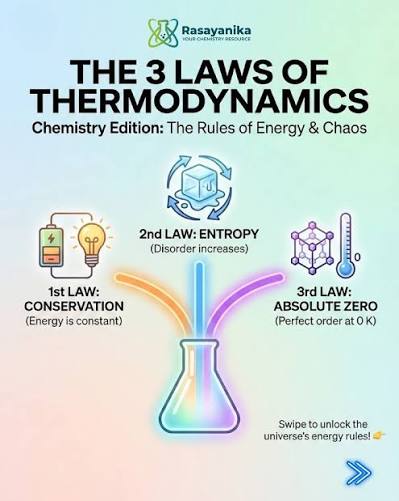
This is only a brief introduction of thermodynamics although we're happy to point you in the right direction with a conspicuous link to the Wiki page which is quite a comprehensive information guide about this interesting subject. As optimism goes, a good understanding of thermodynamics could increase the depth of other fields of expertise and perhaps even compliment if used in the right way. At first glance, it may seem quite natural that there are three fundamental laws of thermodynamics, however after them having been established for some time, there is in fact a zeroth law which has been in use subsequently for many decades. Sometimes it is useful to keep the definitions as pure as you can and most all the material on this area could comply with this definition of the zeroth law :
If two systems are in thermodynamic equilibrium with a third system, then they each have thermodynamic equilibrium.
The law of conservation of energy could in fact be in harmony with other related disciplines such as Newtonian mathematics where there may be several forces in play like momentum, gravity, friction, wind acceleration and so on. The detail here means that with a keen mind, calculations can reliably predict certain outcomes.
The second law of thermodynamics can be simplified to the following phrase :
Heat does not naturally transfer from a cold body to a hot body.
The scenario that is prominent in my mind when thinking about this is of a fridge with an open door. As soon as the door is opened, the cold air sinks to the floor flowing out from the fridge. Before opening that door, the fridge may contain lots of cooler air, however when the door is opened, there is the natural entropy of the air in the room and the air in the fridge which increases the disorder in the combined space becoming more disordered over time. It might help to visualise particles gradually mixing together and becoming more disordered. It may also be noted that temperature is considered empirical, as it only has one dimension.
The 3rd law tells us how the minimum entropy can be achieved using the concept of absolute zero in relation to temperature. When such a system approaches absolute zero, the entropy is typically close to absolute zero. If it were possible to achieve absolute zero, there would be no entropy. From the illustration it appears absolute zero is defined by the term 0 K. The K may stand for Kelvin where the equivalent Celsius and Farenheit are really extremely cold ( much colder than 0 degrees Celsius ).
For more detailed information on this see the Wiki page on thermodynamics.